Why your feet hurt

A warm boot should not cost you your toes

Where you feel it, and what your shoes have to do with it.

A woman standing in the BareYeti boots, side view showing her hips, knees, ankles and the ball of her foot
  1. When your feet are tilted all day, everything above them adjusts to compensate.

    In BareYetiYou keep a natural stance on the trail.

Nothing pressing, nothing tilting, nothing stopping your foot moving.

What you get with BareYeti

A high top winter boot you can pull on with gloves still on

1

Warm from the sole up, not just around

A long plush fleece lining sits over a plush thermal insole. The cold is stopped coming up through the sole as well as in from the sides.

2

Thick socks and room for your toes

The front holds a wide five toe barefoot shape rather than narrowing. You get winter socks and toe splay in the same boot.

3

On and off without taking your gloves off

One pull on the bungee toggle cinches the whole boot, and a heel pull tab gets you in. There are no laces to tie with cold fingers.

4

Grip on snow, wet rock and mud

A deep lugged outsole in tough wear resistant rubber. It bites into loose winter ground rather than skating across it.

5

Snow stays out on deeper ground

The collar sits about four centimetres higher than a low boot. That extra height keeps snow from dropping in over the top.

6

Rain and slush bead off the upper

A water repellent microfiber and nylon upper sheds rain, snow and slush. It is water repellent rather than fully waterproof.

The details, if you want them

Style
Barefoot winter hiking boot
Shoe type
Insulated high top hiking boot
Season
Winter, cold weather
Best for
Winter hiking, snow, camping, cold weather commuting
Upper material
Water repellent microfiber and nylon
Lining
Long plush fleece, wind and cold proof
Insole
Plush thermal over EVA
Outsole
Wear resistant lugged rubber
Sole profile
Zero drop
Toe box
Wide, five toe barefoot shape
Closure
Bungee toggle with heel pull tab
Water resistance
Water repellent, not fully waterproof

Why it works

What BareYeti actually does for your feet

Overhead view of the BareYeti showing its wide barefoot toe box

Warm all the way round, not just underneath

A long plush fleece lining wraps the foot like a wool carpet, over a plush thermal insole that stops the cold coming up through the sole. The wind and cold proof build then holds that warmth in through a long day out.

Side view of the BareYeti showing its level zero drop sole

Your toes still splay, even in winter socks

The front keeps the five toe barefoot shape instead of narrowing the way a winter boot usually does. You get thick socks and room for your toes at the same time, which is the trade most boots make you choose between.

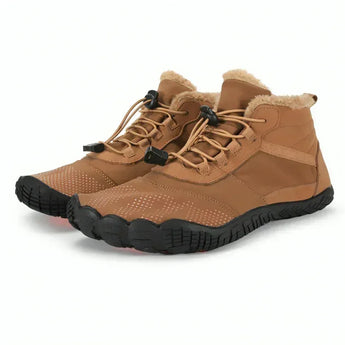
Three quarter view of the BareYeti winter hiking boot

Grip on whatever winter puts under you

A deep lugged outsole in a tough wear resistant rubber. It holds on snow, wet rock, gravel and mud rather than skating over them, and it is built to survive the mileage rather than round off after a season.

Why this pair

BareYeti next to a standard winter hiking boot

In real use
BareYeti
A bulky insulated hiking boot
Over thick winter socks
BareYetiA wide front lets toes splay
A bulky insulated hiking bootThe front narrows and crowds your toes
Getting them on quickly
BareYetiOne pull on the bungee toggle
A bulky insulated hiking bootLaces to tie with cold fingers
Cold rising through the sole
BareYetiA plush thermal insole blocks it
A bulky insulated hiking bootThin footbed lets the cold through
Deep snow underfoot
BareYetiA collar four centimetres taller
A bulky insulated hiking bootSnow drops in over a low cuff
Wet rock and mud
BareYetiDeep lugs in wear resistant rubber
A bulky insulated hiking bootTread rounds off after a season
Standing level
BareYetiHeel and toe sit at one height
A bulky insulated hiking bootA raised heel tips you forward
Weight for the pair
BareYetiLight enough for a long walk
A bulky insulated hiking bootHeavy enough to slow you down
Long days on the trail
BareYetiThe body bends without rubbing
A bulky insulated hiking bootA stiff shell rubs into blisters

The weight

You do not wear your boots. You lift them, about 7,000 times a day.

Every step is a small lift you never agreed to. A normal winter boot is a few ounces heavier than BareYeti. Multiply those few ounces by seven thousand and it stops being a spec on a page.

Put your own sneaker on a kitchen scale and type the number in. The maths is yours, not ours.

18 oz

Weight you stop lifting, every day

0 lb

Based on one shoe lifted per step, at 7,000 steps a day.

Overhead view of BareYeti showing its wide barefoot toe box

Fit and anatomy

Shaped like a foot, not a wedge

Put your foot on the insole. Your toes should sit inside the outline with room to spread.

It gives where your foot needs it to.

Room across the front, even over thick winter socks.

  • Foot shapedtoe box, room to splay
  • Zero dropheel and toe sit level
  • True to sizeelastic laces, nothing to tie

What to expect

The first two weeks

Wear them all day on day one and your calves will punish you for it. That is why most people give up in week one. So here is the fortnight, laid out.

  1. Day one, wearing the BareYeti indoors on a wooden floor

    Day 1 to 3

    A couple of hours

    Wear them round the house.

    Your calves will grumble. Good.

  2. Stepping outside in the BareYeti on a cold winter day

    Day 4 to 7

    Half a day

    Add a short walk outside.

    They start to feel like your own boots.

  3. Sitting outside in the BareYeti after a winter hike

    Day 8 to 14

    Most of the day

    Take them out on frozen ground.

    You feel the ground for the first time.

  4. Walking easily along a frosty trail in the BareYeti

    Day 15 on

    All day, every day

    Wear them everywhere.

    You stop thinking about your feet.

Day one is the day the box arrives.

Questions

BareYeti questions, answered

How warm are the BareYeti boots for winter?

They are made to keep you warm on cold days and winter hikes. Thick fleece insulation lines the boot and an insulated collar seals warmth around your ankle. Add wool socks when the temperature really drops.

Can they handle snow and wet ground?

Yes. The upper combines a water resistant synthetic with waterproof nylon to keep out snow and wet trail conditions. They are built to shed moisture so your feet stay dry on winter walks and hikes.

How is the traction on snow and ice?

The anti slip rubber outsole has an aggressive winter tread that bites into snow, mud, and rough terrain for sure footing on the trail. On solid ice, add traction cleats as you would with any hiking boot.

Are these true barefoot boots?

They are. The BareYeti is zero drop with a wide toe box, so your feet stay level and your toes can spread and grip, even in a warm mid ankle winter hiking boot. You get the barefoot feel with cold weather protection.

Should I size up for thick socks and hikes?

The BareYeti fits true to size for most people. For winter hiking in thick socks, or if you have wider feet or are between sizes, size up half a size for room to layer and let your toes splay. These are US sizes, with separate women and men sizing switched at the top of the page.

How do I care for the boots and fleece lining?

Knock off dried mud, then wipe the upper with a damp cloth and mild soap to clear trail grime and salt. Loosen the quick pull lacing and air out the fleece lining between wears. Let them dry naturally away from direct heat, and do not machine wash them.

What is your return policy?

The BareYeti is backed by a 30 day money back guarantee. If they are not the right fit, reach out within 30 days for a full refund. We ship to the US and CA.